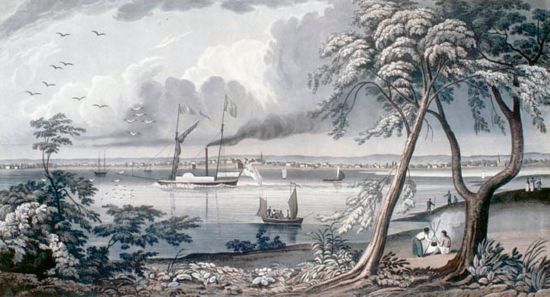
Indigenous Acknowledgement and Contributions to the Battle of York
YORK, GIBRALTAR POINT, 1828 | James Grey (fl. 1828) | Library & Archives Canada, C-002046
Introduction
Theme: Connecting Past to Present, Indigenous and British Alliances
Indigenous peoples have been here on Turtle Island since time immemorial, well before the formation of what we know as Canada, today. It has only been recently since the Canadian government has been making larger efforts to mend their relationship with Indigenous peoples such as enactment of the Truth and Reconciliation Commission of Canada, which is a promise to help heal the hurt relationships due to the enforcement of residential schools. Despite the major and key roles Indigenous people have played throughout the making of Canada, our history books have often overlooked and omitted their very existence. This is why it is so important to acknowledge Indigenous peoples history and educate others on their contributions to our society.
Significance: Fort York is doing great work in highlighting and educating the GTA about the Indigenous contributions to Toronto’s history. They are continually looking for outreach opportunities to celebrate and honour Indigenous peoples and my hope is that this activity aids in that. This plan also aligns with the Grade 7 History curriculum goals that include being able to analyze the lives of various Indigenous communities between 1800 and 1850s.
- More here: https://www.dcp.edu.gov.on.ca/en/curriculum/elementary-sshg/grades/g7-history/overview
Rationale: This lesson plan allows participants to explore the lesser-known parts of the Battle of York during 1813, through the exploration of Indigenous contributions and collaboration of the protection of both Canada and Toronto’s landscape. Together, both seniors and youth are invited to make meaningful connections to our shared history as inhabitants of Canada and learn about the ongoing significance of Indigenous peoples in both our past and present. Through this unique intergenerational learning opportunity, youth and seniors will be able to gain knowledge from one another and experience community learning.
Audience: This lesson plan is intended for the mixed audience of Gr.7-8 Students (12-13 yrs) and Seniors (~65+ yrs).
Setting: While in collaboration with Fort York, this lesson plan is formatted so that it can be activated in spaces outside of the Fort, such as both in-person and online classrooms. Ideally, students would go on a field trip to meet the senior participants where they are! Try organizing this event in senior housing or their local library, this will provide unique opportunities for students to develop deeper intergenerational connections and experiences.
- If online, please ensure to use of video call software that allows for breakout rooms and accessibility features (like transcripts) such as Microsoft Teams and Zoom. This is to best ensure everyone can fully participate and the ability to separate groups from the main room.
Duration: Approximate time to complete this is ~30 minutes.
Group Set-Up: Mixed groups of seniors and students will be organized. They will work in these groups to tackle questions and share their responses to discussion. To best encourage peer-to-peer as well as intergenerational connections, please split youth and seniors up to a minimum and recommended 2:1 ratio. This allows the students to not feel isolated when working with the elderly and also promotes easier conversation between the different age groups. Seniors are asked to help facilitate conversation between them and students while learning and engaging with pedagogical activities.
Learning With Objects: Alliances Made Between Indigenous Peoples and the British
Object Choices: Digital objects of different media are utilized throughout this plan to help cultivate and stimulate a variety of connections and interests. (Both the physical painting and photograph can be viewed in-person at Fort York and all images are readily available online to the public, sources included.) Each object is tied to significant events that record Indigenous influence and involvement in the time surrounding the War of 1812. By teaching with objects, thorough exploration of the attitudes and happenings around Indigenous contributions are achieved with the use of Visual Learning Strategy questions. Proceeding context and discussion points, example questions are provided to encourage personal connections and wrap-up each object activity.
Object 1: Painting of the meeting between Brock and Tecumseh
THE MEETING OF BROCK AND TECUMSEH, 1812
C.W. (Charles William) Jefferys (1869–1951) | Library & Archives Canada, C-O73719
Context: Both Brock and Tecumseh were key players in the success of defending Canadian borders. Captured here is the respectful interaction between British Major-General Sir Isaac Brock and Shawnee War Chief Tecumseh, where both men are impressed with one another and see each other in high esteem. Tecumseh commanded 2,000 warriors throughout the war and stopped American territorial expansion. He was not the only war chief to proudly manage and represent his tribe during the ongoing battles, there are many others from other Indigenous tribes who helped defend borders.
This historical painting is remarkable because it portrays a positive alliance between the British and Indigenous people. Oftentimes, we might encounter very negative representations and harmful attitudes about Indigenous peoples from those around us, textbooks, and social media. These damaging opinions of Indigenous peoples originate from how they've been treated throughout North American settlement and the stealing of their land. The Battle of York was a very collaborative time where all inhabitants of many nations came in agreement and harmony with one another to defend their home against American expansion.
1. What examples of 'alliances' or 'deals' have you made with other people in your own lives? Your gaurdians? Siblings? Friends?
2. How does/did having those set agreements make you feel?
3. What other types of alliances might you see around the world?
Object 2: Studio portrait taken in July 1882 of the surviving
Six Nations warriors who fought with the British in the War of 1812
SIX NATIONS VETRENS, 1882 | Ed Tompkins, Jeffrey Thomas | Library and Archives Canada, C-085127
Discuss: Indigenous communities such as (and not limited to) the Shawnee Tribe, Mohawk, Metis, Six Nation, Dakota, and First Nations all contributed to the War of 1812. Do you recognize any of these names? Even though so many Indigenous soldiers and leaders served during the war, the documentation of their lives and contributions is miniscule compared to their British counterparts. Despite so many Indigenous soldiers from different tribes serving our country, they have gotten blanked out from historical texts, visual media, and physical artifacts. This is why it is so important for Canadians to be educated about Indigenous perspectives! It is a way of honouring our elders who have made the Canada where we work, learn, play, and rest.
1. How much did you previously know about Indigenous history, prior to this activity?
2. What other things might you be curious about regarding the lives of Indigenous people here in Canada?
3. What are some ways we can continue building new alliances with Indigenous communities and peers?
Studio Activity: Friendship Awards
Object 3: King Geroge III Silver Peace Medal
 |
| Front-side of Medal |
 |
Back-side of Medal
|
King George III silver peace medal. 65.15. Kravis Discovery Center. cast in 1814. Tulsa: Gilcrease Museum, https://collections.gilcrease.org/object/6515 (07/17/2017).
Discussion: Throughout this activity, students have gotten the privilege to work closely with senior volunteers. These images are “Peace Medals,” that were created by the British to commemorate the military services of Indigenous allies. Created to honour and thank them for their contributions to the war. The British met Indigenous warriors and presented them these gifts as tokens of loyalty and friendship!
Studio Activity: In this studio activity, please invite the students to draw medals of thankfulness and friendship towards the seniors who worked closely with them in their groups. Invite the students to present their medals in front of the class to their senior partners, just as they would of done at official commemoration ceremonies. Let this be the start of ongoing collaboration, an alliance if you will, between your class and the senior group.